 |
I was recently asked in an interview “Why Belgium?” to which, with a grin, I shot back the answer “for the chocolate.” My reply offered thinking time to dwell on a more earnest response such as “seriously though, having taken a module in European politics I was drawn to Brussels as it is at the core of European decision making.” Truthfully, as a young, carefree, and admittedly rather naive first year student, the choice between Rome and Belgium had been a difficult one. Pizza or waffles? Pasta or chocolate? The allure of chocolate won out.
Now, however, I adore this charming little country (which could fit inside the U.S. 300 times), where some of the most famous “people” are TinTin and Hercule Poirot, and, arguably, their most famed landmark is a fountain of a urinating child. Yet the experience of studying, working and living in Belgium taught me so much more; it was a passage of enlightenment taking me from being a naive isolationist to becoming a true European.
Home Base: The University of Exeter in the U.K.
I chose to go to the University of Exeter as it was the only university in the U.K. where I could study Economics and Politics and still spend a year abroad. While all other universities required you to study (for example) Economics and Russian or Politics and Portuguese, this course allowed me to combine my passion for the social sciences (not languages) with an opportunity to experience another society and increase my cultural awareness.
I am fortunate to be one of over 1.5 million students who has benefited from the Erasmus programme. The European Commission offers each student a grant with the aim of increasing student mobility within Europe and promoting transnational co-operation projects among universities across Europe. While the benefit to the European Union as a whole is unclear, the experience greatly benefits individuals, who return from their year abroad more confident, independent, and with an enhanced C.V.
Vlekho Business School in Brussels
My home university is linked to Vlekho Business School in Brussels—a relatively small business school. Having since met people studying at other educational establishments in Belgium, I realize that the business school had both its positive and negative aspects. As a “hogeschool” (Dutch for “high school”), it does not have the prestige of other, more esteemed institutions, but it does offer a more friendly and welcoming environment that other higher education organizations may lack. It is important that each student assess what he or she is expecting from a university or college and researches as much as possible before embarking on the program. If you are seeking a larger university in Brussels, for example, you should ask your home university if you can do an exchange with Université Libre de Bruxelles, rather than simply accepting your placement at a hogeschool. I was very happy at Vlekho, where I could take modules which involved business management games—a very different approach from the theoretical and conceptual structures I had been taught at Exeter, and leaving me with a better and more rounded knowledge base.
Which Language to Learn? French or Flemish?
Once I had decided to move to Brussels, I took up a course at Exeter in Intermediate French (Brussels is 80% Francophone); but, as it turned out, to little avail. Belgium is a small country with something of an identity crisis—it has three national languages (French, Flemish, and a small minority of German). I had thought that my year aboard would help to increase my language skills, but unfortunately my preparation and research failed to alert me to the fact that Vlekho Business School was indeed a Flemish school, and that the majority of students would therefore speak Flemish rather than French.
Finding a Place to Live in Brussels
Brussels is a large city, over 160 km2 (62 square miles) and with a population of approximately 1,080,790, so finding a place to live was daunting. Once again, it is important to do some research and assess what you are looking for from your accommodations. Some students opted to live with a host family, which gave them a truly Belgian experience, while others rented an apartment (which had the downside of requiring a yearly contract despite the fact that we were participating in a 9-month program). You can find apartments in newspapers such as Vlan or De Sreekkrant. Another drawback of living in an apartment is that even if it is fully furnished you must provide your own mattress—something many students had not anticipated, and which proved somewhat difficult to obtain with no access to a private transport.
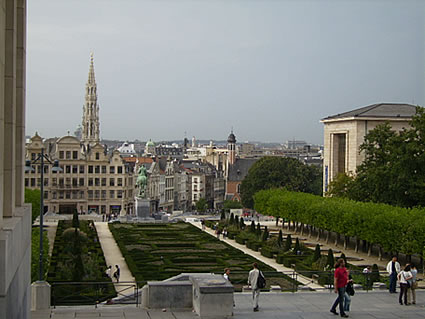
Personally, I opted to live in Quartier Latin, Brussels International Students Center, which had only just opened. As the name implies, it offers accommodations to students from all over the globe, and is a fantastic way to meet new people. The lodging was set in the beautiful building which was an old bank, and although when I moved in the center was not completely finished, over the course of my stay I saw many improvements, such as the addition of laundry machines and the television rooms. The people who ran the center were helpful and the rent was inexpensive. Being in the center of the city, It was also ideally located. In just a few minutes you could jog from the center to Brussels Park (Parc de Bruxelle in French or Warandepark in Dutch), the largest urban public park in Brussels—which is bordered by the stunning buildings of the Royal Palace of Brussels, the Belgian Parliament, and the U.S. embassy. In the summer, free parties are organized at the park every weekend.
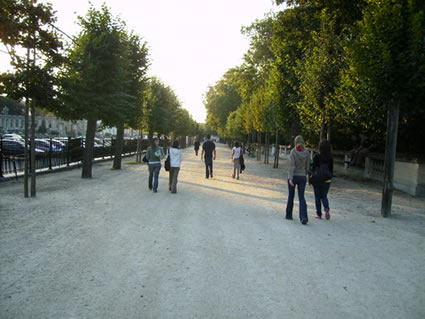 |
| In the Parc de Bruxelles with some friends. |
Making the Transition
Initially, I had no Internet connection. In hindsight, this was probably a good thing, as instead of spending spare time staying in contact with friends at home I was able to immerse myself in a new life and concentrate on building new friendships. As I had left my university friends behind to graduate without me, I felt somewhat in limbo—not really part of the University of Exeter anymore, but not quite wholeheartedly throwing myself into this new experience either. It is important to fully embrace the study abroad experience with enthusiasm, and once the initial homesickness wore off, this is precisely what I did.
Studying in Brussels gave me amazing opportunities to meet other students from all over Europe and Latin America who had come together in this multicultural and cosmopolitan city. I do not believe that you can truly understand a nation and its people unless you learn its language(s), and, when I return to live in the Benelux I intend to complete an integration course in order to live as a Dutch person, rather than as a foreigner. While it was a shame that during the year my language skills did not improve—as the common language between us remained English—there was a reward it that I learned about cultural differences which shaped my understanding of the world around me. The opportunity to meet so many people from different countries also gave me the chance to confirm or challenge existing stereotypes.
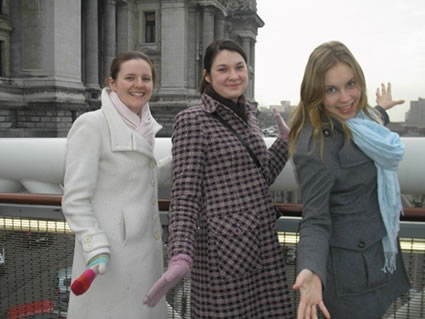 |
| Friends Philippa and Clare came to visit. Author is on the far right. We are standing in front of the Palace of Justice. |
Living in Brussels: Practicalities
Regardless of whether you are an EU national or otherwise, if you are planning on staying in Belgium for more than three months, you must register at the local municipality (belgium.angloinfo.com/countries/belgium/residency.asp) within eight working days of arriving (usually this can be done at the local Town Hall).
When you arrive it will also be important to set up a bank account. Be aware that there may be a charge for opening and closing an account, though this might be dropped if you are a student. I banked with ING, as it was just opposite my school. One reason it is so important to have a bank account is that you will find that many stores, parking meters, vending machines, etc. use Proton, which is an electronic purse card. If you pay by cash for certain items, you may be charged more, and so it is sensible to have a Proton card.
For the student, another money saving tip is to register for a yearly travel card (at only 25€), allowing you to really get to see and know the city. However, this card is subsidized by the Flemish government, and therefore is only available for students studying at Flemish universities and hogeschools. Be aware that—as there are only a limited number available—they are only offered to students who are planning to stay in the city for a year, and therefore the station officials are required to see an annual renting contract. There are also only so many obtainable per day, and so it is important to start queuing early. I spent two days getting up at 5.30 a.m. to go to the station to get a ticket; on the third day I simply stayed up all night!
Regardless of the country you move to, there will be many small and seemingly unimportant yet frustrating questions you may have. Discovering the answers to these is all part of the journey; from a rhetorical “why is nothing open in a capital city on a Sunday?” to “where oh where can I go to get some ‘proper’ milk?” (for example, if in Brussels try a GB Supermarket).
Studying in Brussels
Unlike those who take a particular course, foreign exchange students have a lot more freedom to choose their modules, something I was used to given the nature of U.K. syllabuses. However, I was accustomed to choosing four modules each semester, instead of needing to make up 30 credits in many modules offering as few as two or three credits, as some classes would last as little as four weeks. Initially I started taking Dutch lessons, but unfortunately this clashed with a class that I needed to take as it offered more credits. It was very difficult for students to ensure that they obtained the correct amount of credits, so fortunately the tutor at my home university was very obliging, and allowed students to make up the difference with language classes or to take an extra exam after they returned to Exeter. My advice would be: if in doubt, ask questions. It was important to ensure that my home university was happy with any decisions so that I would fulfill the requirements in order to pass the year, and so I emailed my home tutor fairly regularly. However, I found that my best source of information came from fellow students, who were also trying to master the irregularity of their timetable.
I also found that examinations were completely different from those taken in the U.K. They ranged from an open book exam where you could take your study materials and notes into the examination, to an oral exam where it was imperative to remember all aspects of the course. This variation was reflected in my marks, from 100% for the open book exam to nearly failing the oral. If you are not familiar with spoken exams I would suggest practicing questions with a classmate. I found that having never experienced a spoken examination, my nerves hindered my performance.
 |
An Internship in Brussels
In my second semester I opted to complete an internship to provide valuable work experience which I believed would not only enhance my employability, but would also offer a chance to experience Brussels from the perspective of a worker rather than simply from that of a student. In the first semester I had settled in, taken every opportunity to socialize and create new friendships, and had learned about Business Studies from an academic point of view (something which was a pleasant change from the Economics that I studied for the past two years). Now I wanted to experience the business world for myself.
In the summer before I left for Belgium, I bought the book Live & Work in Belgium, The Netherlands & Luxembourg, which listed some of the major employers in Brussels. As I knew that I sought a career within the financial sector, I sent my C.V. and cover letter to one of the large American banks listed in the book in order to enquire about internships. I also visited my host tutor who offered contact details for alumni from Vlekho who were working in banking, whom I subsequently contacted. Completing this internship has since given me “the edge” when applying for entry level jobs, as in addition to increasing my knowledge of the banking markets and products, it demonstrated my proactive attitude as I had sought out and undertaken a voluntary internship.
Work Ethic in Belgium
There appeared to be a different work ethic in Belgium compared to that in the U.K. Lunchtime is a time for socializing and eating, not for sitting at your desk, and if you are a 9-5 worker, then that is, literally, what you are. Belgians are recognized as being the most productive workers in the E.U., which surely makes them very efficient and effective during the actual time that they are at work. When compared to the hours actually worked by Brits, the actual hours worked by Belgians are significantly less.
Traveling from Belgium
A major advantage of living in a small nation such as Belgium is that there is the opportunity to easily visit neighboring countries. I took the coach from Brussels to Amsterdam to meet up with a friend, and I also took the train through Germany to Austria to attend my sister’s wedding. Moving so freely between countries has changed my idea of “Europe” as a concept. Previously I had thought of it as separate nations comprising a continent, but when there are no checkpoints on the roads between countries, and by train you may be in Belgium one minute and Germany the next, it is difficult to physically see where one country ends and another starts. Now that the U.K. is connected by Eurostar to mainland Europe, I feel that it is now more symbolically connected to the notion of Europe.
Although there is free movement of Europeans between countries, I do feel that mainland European countries are more united than the U.K. is to its counterparts. Geographical differences (when cycling in the south of Holland, you do not know when you have passed the border of Belgium) and language differences (English cannot be mistaken for another language in the way that Flemish and Dutch overlap) are less obvious. This distinction between defined countries blurs even more on the mainland as it uses a single currency, while us obstinate and unyielding Brits continue to use the pound and drive on the “wrong” side of the road. Nevertheless, I now see Britain as part of Europe, rather than simply as part of an open trade market. Having been born in the U.K., I consider myself fortunate to be able to have the opportunity and freedom to live and work in a continent that offers such a diverse variety of cultures—from the friendly and laid-back “siesta then fiesta” southern Europeans to the generally shy and more introverted northern Europeans. I began my journey of a year abroad as an uninformed and naïve student who thought herself to be “going to live in Europe for a year.” Now I consider myself a European with a greater global awareness.
I went to Belgium knowing only of its chocolates, waffles, beer and TinTin. The country does encompass these things, but it is also so much more. Brussels radiates a calm sense of craziness, where visitors go on pilgrimages to seek out a statue of a boy that urinates, where cartoon characters line its walls and fully grown men read comic strips on their way to work; and where the citizen’s jobs require them to debate how straight a banana may be or to deliberate exactly what constitutes butter. This eccentric city expanded my understanding of the world around me, broadened my horizons and taught me to be more socially accepting (in my final year at university I acted as a mentor to incoming Erasmus students). Belgium itself is currently politically unstable and yet Brussels is the political heart of Europe. In a country so confused about its very own identity, I found that I was able to define mine.

 , a guidebook for getting you started on an exciting, overseas adventure:


